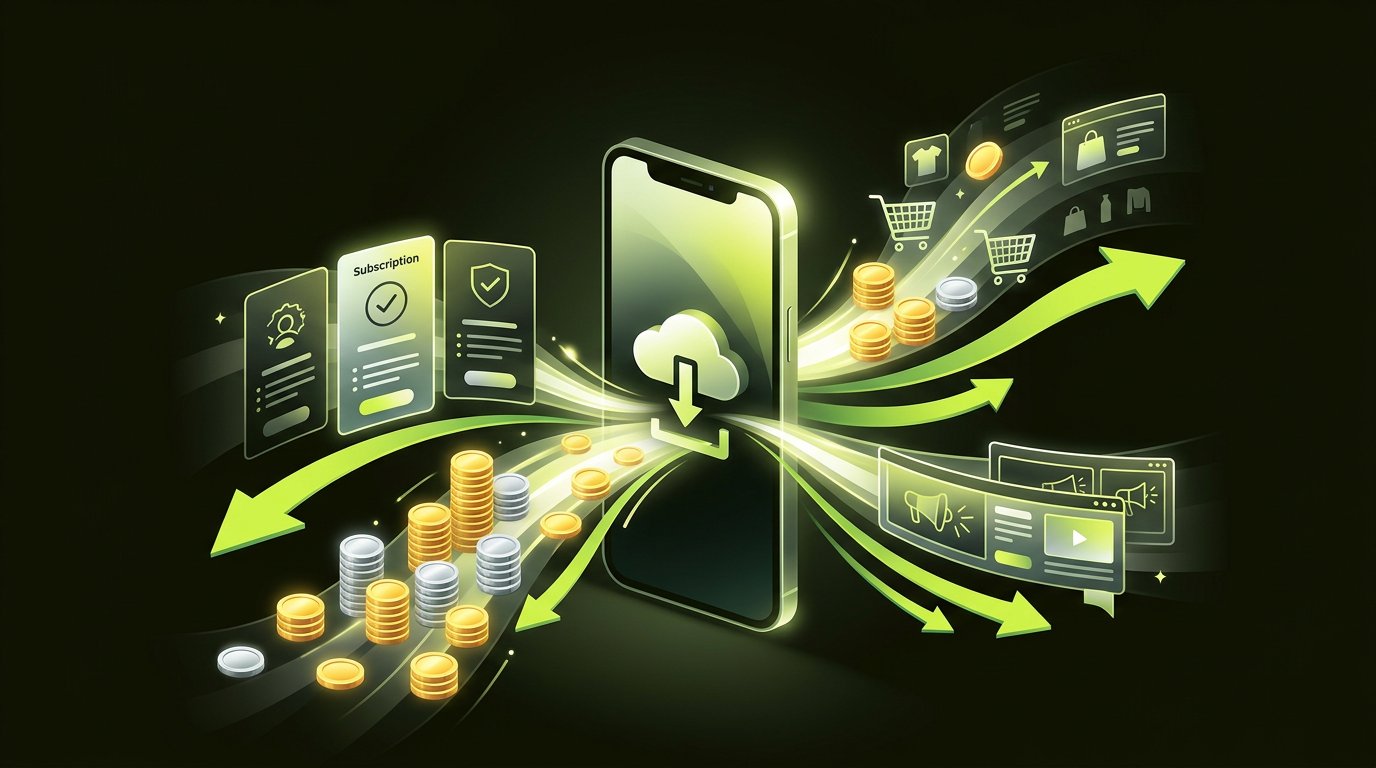
Free apps make money through eight models: advertising, freemium upgrades, subscriptions, in-app purchases, transaction fees, sponsorships, data products and hybrid combinations. The typical pattern: free gets you distribution, then 2–5% of users pay for everyone. A million downloads means nothing by itself; a thousand paying users is a business.
Here is how each model actually works in 2026 — with the numbers that decide whether a free app is a hobby or a company.
The eight monetization models
1. Advertising
Banner, interstitial, rewarded video and native ads pay per impression and click. Benchmarks: $1–10 per 1,000 impressions depending on geography and format; rewarded video the highest, banners the lowest. The math is brutal at small scale — 10,000 daily users generate perhaps $30–100/day. Advertising works when audience is huge or time-on-app is long. It is the default monetization for content and casual game apps.
2. Freemium
The app is free; power features cost money. The conversion reality: 2–5% of registered users upgrade on average, world-class freemium converts 8–10%. The design discipline is giving away the core value while charging for scale, convenience or depth. Note the inversion: freemium is not about limiting the free tier — it is about making the paid tier worth buying.
3. Subscriptions
Recurring revenue for ongoing value: content, software capability, community. The benchmarks that matter: monthly pricing converts 2–3x annual plans, trials convert 8–25% to paid, and churn above 7% monthly eats most models. Subscriptions have become the default for tools and content apps because revenue compounds while ad revenue resets to zero monthly.
4. In-app purchases
Consumables and unlocks — coins, levels, cosmetics. Gaming's classic engine: whales (top 1% of spenders) drive 30–60% of revenue in many titles. Outside games, IAP works for digital goods with perceived value: filters, templates, boosts.
5. Transaction fees
Marketplaces and fintech: take a percentage of the value flowing through. Ranges from 1–3% (payments) to 10–30% (marketplace commissions). The strongest model when it applies — revenue scales with customer success — and the hardest to bootstrap, because liquidity must come first.
6. Sponsorships and partnerships
Brands pay for placement, integration or exclusive access to your niche audience. Underrated for focused communities: an app serving 50,000 dentists can out-earn a generic app with a million users.
7. Data and insights
Anonymised, aggregated, privacy-compliant market intelligence from usage patterns. Legitimate and regulated — and a model that must be disclosed honestly, because trust is the actual asset.
8. Hybrid
What most successful apps actually run: ads for free users, subscription to remove ads and unlock premium — the Spotify and YouTube pattern. The free tier monetizes the unwilling; the paid tier serves the committed.
The benchmark math
For an app with 100,000 monthly active users:
- Ad-funded (casual utility): $500–3,000/month
- Freemium with 3% conversion at $5/month: $15,000/month
- Subscription with 2% conversion at $10/month: $20,000/month
- Marketplace with 5% transaction take on $15 average order: depends entirely on order volume — and beats all of the above when liquidity exists
The strategic insight hiding in those numbers: conversion rate and price are product decisions, not marketing decisions. The monetization model should be designed into the product from the first screen, not bolted on after launch.
Choosing your model
- High frequency, long sessions (content, social, casual games)? Advertising plus optional ad-removal subscription
- Ongoing value (tools, learning, health)? Subscription with a genuine free tier
- Value exchange between users (marketplaces, delivery)? Transaction fees
- Emotional or competitive value (games, dating, creation)? In-app purchases
- Niche professional audience? Sponsorship and premium hybrid
And the model can evolve: many apps launch ad-funded, learn who their power users are, and introduce subscriptions for exactly those users. The mistake is not starting monetization until user growth stalls — then the funding runway is gone and the data needed to design monetization was never collected.
What this means if you are building one
The monetization model changes what gets built — a subscription app instruments trial conversion, an ad-funded app optimises session length, a marketplace solves liquidity first. That is why monetization belongs in discovery, not post-launch: it is cheaper to design the funnel than to retrofit it. The same logic drives the build decisions in our app development cost guide — the features worth paying for are the ones the business model depends on.
One honest warning
Every model above dies without retention. The median app loses 90%+ of users within a month; no monetization survives that. Retention is the product; monetization is the pricing. Our mobile app development team instruments the retention metrics that matter from the first release — because a free app that keeps users has eight ways to make money, and one that loses them has none.
Frequently asked questions.
How do free apps make money?
Through eight models: advertising ($1–10 per 1,000 impressions), freemium upgrades (2–5% conversion), subscriptions (trials convert 8–25%), in-app purchases, transaction fees, sponsorships, data products, and hybrids. Most successful apps combine two or more.
How much money does a free app with ads make?
Roughly $1–10 per 1,000 impressions depending on format and geography. An app with 10,000 daily active users might earn $30–100/day from banners, more with rewarded video. Advertising is viable at scale — which is why most ad-funded apps are content, social or game apps with long sessions.
What percentage of free users upgrade to paid?
Average freemium conversion runs 2–5%; world-class execution reaches 8–10%. Monthly plans convert 2–3x better than annual for the first purchase. Improving conversion is a product-design problem: the paid tier must solve a problem the free tier deliberately leaves open.
Which is better: ads or subscriptions?
Subscriptions for apps delivering ongoing value (tools, content, health); ads for apps with high frequency and long sessions that users will not pay for directly. The strongest pattern is hybrid: ads monetise free users while subscriptions serve committed ones.
Can an app be profitable without users paying?
Yes — through advertising, sponsorships, transaction fees on commerce flows, or aggregated data products. But all four require scale or strong niche density first. A free app with weak retention has no monetization path; retention is the prerequisite for every model.
Enjoyed this? Let's talk about applying it to your product.