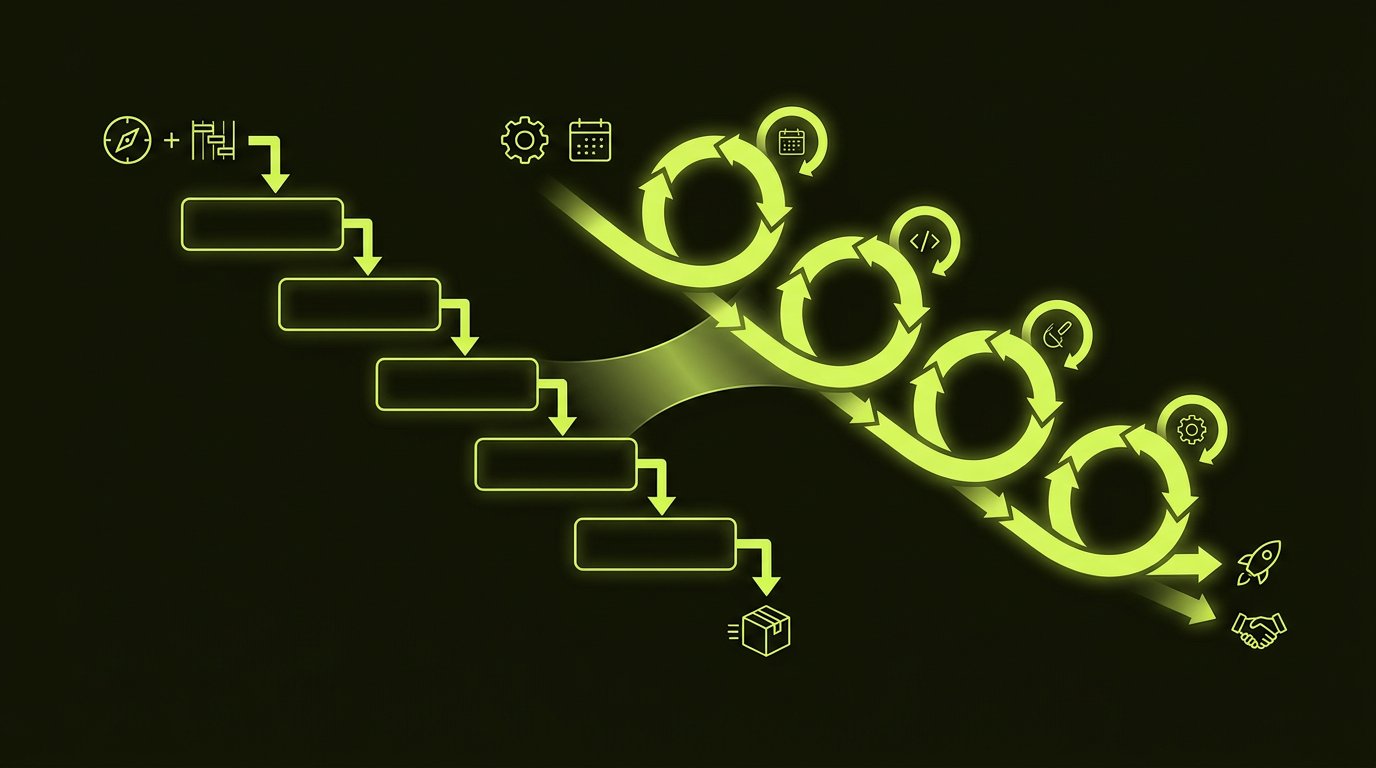
The SDLC (software development lifecycle) is the sequence every project moves through: planning, analysis, design, implementation, testing, deployment, maintenance. Waterfall runs the sequence once, front to back; agile runs it in short loops, repeatedly. The methodology debate is mostly settled — agile won the software mainstream — but the honest comparison matters, because methodology predicts project success far less than two other factors.
The phases, once
- Planning: scope, feasibility, budget, timeline — the decisions discovery exists to formalise
- Analysis: requirements documented — what the system must do, for whom, at what quality bar
- Design: architecture and interface — the system's shape before its substance
- Implementation: the code
- Testing: verification against the requirements — and validation against reality
- Deployment: release, migration, the go-live itself
- Maintenance: the 15–20%-of-build-cost-forever phase every cost guide insists you budget
Waterfall, honestly
Each phase completes before the next begins; requirements freeze early; the delivery lands at the end. Strengths: predictability of scope and cost when requirements are genuinely stable; audit trails that regulated industries require; simple vendor contracts. Weaknesses: feedback arrives at the end, when changes cost most — and requirements are never genuinely stable for software that matters. Waterfall survives where the work resembles construction (fixed, knowable, regulated) rather than discovery.
Agile, honestly
Short iterations (sprints) each running plan-build-test; working software every one to two weeks; requirements evolve with feedback. Strengths: early and continuous feedback, course correction while it is cheap, morale from shipping. Weaknesses: 'agile' without discipline becomes undisciplined churn — scope drift disguised as responsiveness, estimates that never converge, and the standup theatre that replaces management. Agile is a discipline, not the absence of one.
The honest comparison
- Requirements stability: stable and contractual → waterfall tolerable; evolving → agile, genuinely
- Feedback availability: users reachable throughout → agile; users reachable once (compliance sign-offs) → staged waterfall
- Cost of change: late-breaking change is waterfall's failure mode and agile's normal Tuesday
- Regulated domains: waterfall's documentation survives audits better; agile's working increments integrate better — hybrid wins in practice
What actually predicts success
Two factors outrank methodology in every serious study: user involvement and executive clarity. Projects with engaged users and an empowered, decisive sponsor succeed under either methodology; projects without them fail under both. The methodology choice is real but second-order — which is why our development engagements lead with discovery and decision SLAs and treat the process label as configuration. The waterfall-agile hybrid most enterprises actually run — agile builds inside waterfall-defined gates — is pragmatism, not heresy.
Choosing for your project
Building software whose requirements you are still learning? Agile — in the disciplined form: discovery first, sprint cadence, demos weekly, scope decisions explicit. Building to a fixed, inspected, regulated specification? Staged delivery with waterfall's documentation discipline. Either way, the success factors remain the users and the sponsor — invest there before the methodology debate. Book a consultation with the project; the process follows.
Frequently asked questions.
What is the SDLC?
The software development lifecycle: planning, analysis, design, implementation, testing, deployment and maintenance — the sequence every software project traverses. Methodologies differ in how they traverse it: waterfall runs the phases once in order; agile loops through them in short iterations.
Is agile better than waterfall?
For software with evolving requirements and accessible users, yes — agile's continuous feedback catches problems while they are cheap. For fixed, regulated, inspection-driven specifications, waterfall's documentation and stage gates fit better. Methodology is second-order anyway: user involvement and executive clarity predict success more strongly.
What are the SDLC phases?
Planning (scope, feasibility), analysis (requirements), design (architecture), implementation (code), testing (verification), deployment (release) and maintenance (the 15–20%-of-build-cost annual phase). Every methodology traverses the same phases — they differ in sequence and repetition.
Can agile and waterfall be combined?
Yes — and most enterprises actually run the hybrid: agile build teams inside waterfall-defined gates (contract milestones, compliance sign-offs, release trains). It is pragmatism, not heresy, though it requires protecting the team's iteration rhythm from the gate bureaucracy.
What actually makes software projects succeed?
User involvement and executive clarity outrank methodology in every serious study: engaged users catch wrong directions early; an empowered, decisive sponsor prevents decision latency. Projects with both succeed under either methodology; projects without them fail under both.
Enjoyed this? Let's talk about applying it to your product.