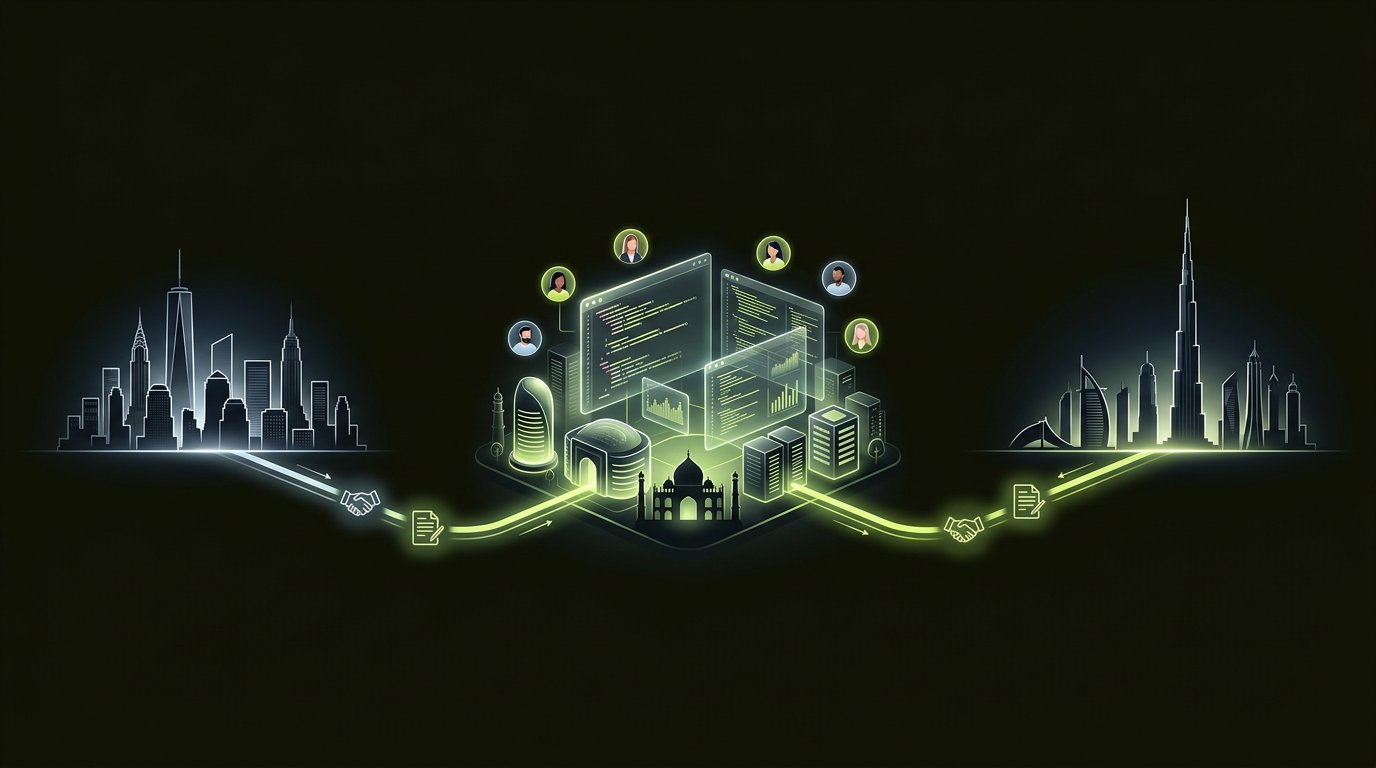
The USA and the Gulf are the world's two largest software-outsourcing demand centres, and both now run the same quiet pattern: local strategy and relationships, Indian engineering — because India-based teams deliver identical scope at 40–60% below both markets' rates. This guide covers the local numbers, the economics of the shift, and the hybrid model that has become the default rather than the workaround.
The USA: the world's biggest buyer
- Local rates: $100–250/hour; senior-heavy boutiques at the top of the range
- The pressure: engineering salaries, venture discipline and competition squeeze margins simultaneously — outsourcing moved from cost play to survival tactic
- The behaviour: US agencies subcontracting Indian teams is now standard practice; the majority of mid-market 'American' development includes Indian execution — see how to hire developers in India
The Gulf: the premium market
- Local rates: $30–80/hour (AED 110–290); the premium tier excellent, the median priced above its delivery
- The pressure: Vision-2030-style digital agendas demand engineering capacity the local talent pool cannot yet supply
- The behaviour: Gulf enterprises pair regional presence with Indian engineering — the timezone overlap (2.5–3.5 hours) is the closest India gets to anywhere, making the corridor the most developed outsourcing route in the world
Why both markets choose India
- The rate gap: $20–60/hour for senior India-based engineers against $100–250 (US) and $30–80 (Gulf)
- The scale: 1.5 million engineering graduates yearly and three decades of outsourcing infrastructure — teams of 20+ staffed in weeks, not quarters
- The maturity: IP frameworks, compliance discipline and engagement models built for exactly these buyers — the full playbook in our outsourcing to India guide and the outsource hub
The hybrid pattern, concretely
What 'local strategy, Indian engineering' looks like in practice:
- Onshore: the account relationship, requirements conversations, the decision cadence with business stakeholders
- India: the engineering organisation — design execution, development, QA, maintenance — often graduating to a dedicated ODC at scale
- The mechanics: weekly demos, your repo and accounts, one empowered decision-maker per side — the disciplines that make distance invisible
For US clients, the timezone gap (India's evening = US morning) runs on written-first rhythm; for Gulf clients, the near-full daytime overlap makes it the easiest outsourcing corridor anywhere.
Choosing the shape for your company
- First offshore engagement: a scoped project with a discovery-first India team — our pricing shows the structure
- Growing capacity: staff augmentation at $4,500–8,000/engineer/month
- Sustained scale (5–15+ engineers): the dedicated center
- Any stage, any market: bring the project to a scoping call — the honest answer includes whether the local premium serves you or the hybrid serves you better, with the numbers on both sides.
Frequently asked questions.
Why do US companies outsource to India?
The rate gap — $20–60/hour for senior Indian engineers against $100–250 onshore — plus India's scale (1.5 million engineering graduates yearly) and three decades of outsourcing infrastructure. Most mid-market US development already includes Indian execution, much of it through agencies subcontracting quietly.
Why do Dubai and Gulf companies outsource to India?
Digital-agenda demand outstrips the local talent pool, and the Gulf-India corridor is the world's easiest outsourcing route: 2.5–3.5 hours of timezone overlap, deep cultural familiarity, and 40–60% savings against Gulf rates of $30–80/hour.
What is the hybrid outsourcing model?
Local presence for strategy, relationships and decision cadence, paired with India-based engineering for execution — applying the 40–60% rate saving to the majority of project cost. It has become the default structure for US and Gulf buyers rather than a workaround.
How do US timezones work with Indian teams?
India's evening overlaps the US morning — a deliberate 3–4 hour window for decisions and demos, with written-first communication carrying the rest. Gulf clients get near-full daytime overlap, the easiest corridor anywhere.
Should we start with a project or a dedicated team?
Start with a scoped project through a discovery-first India team to prove the model on your work; graduate to staff augmentation for growing capacity and a dedicated ODC at sustained 5–15+ engineer scale. Each rung assumes the disciplines of the last.
Enjoyed this? Let's talk about applying it to your product.